
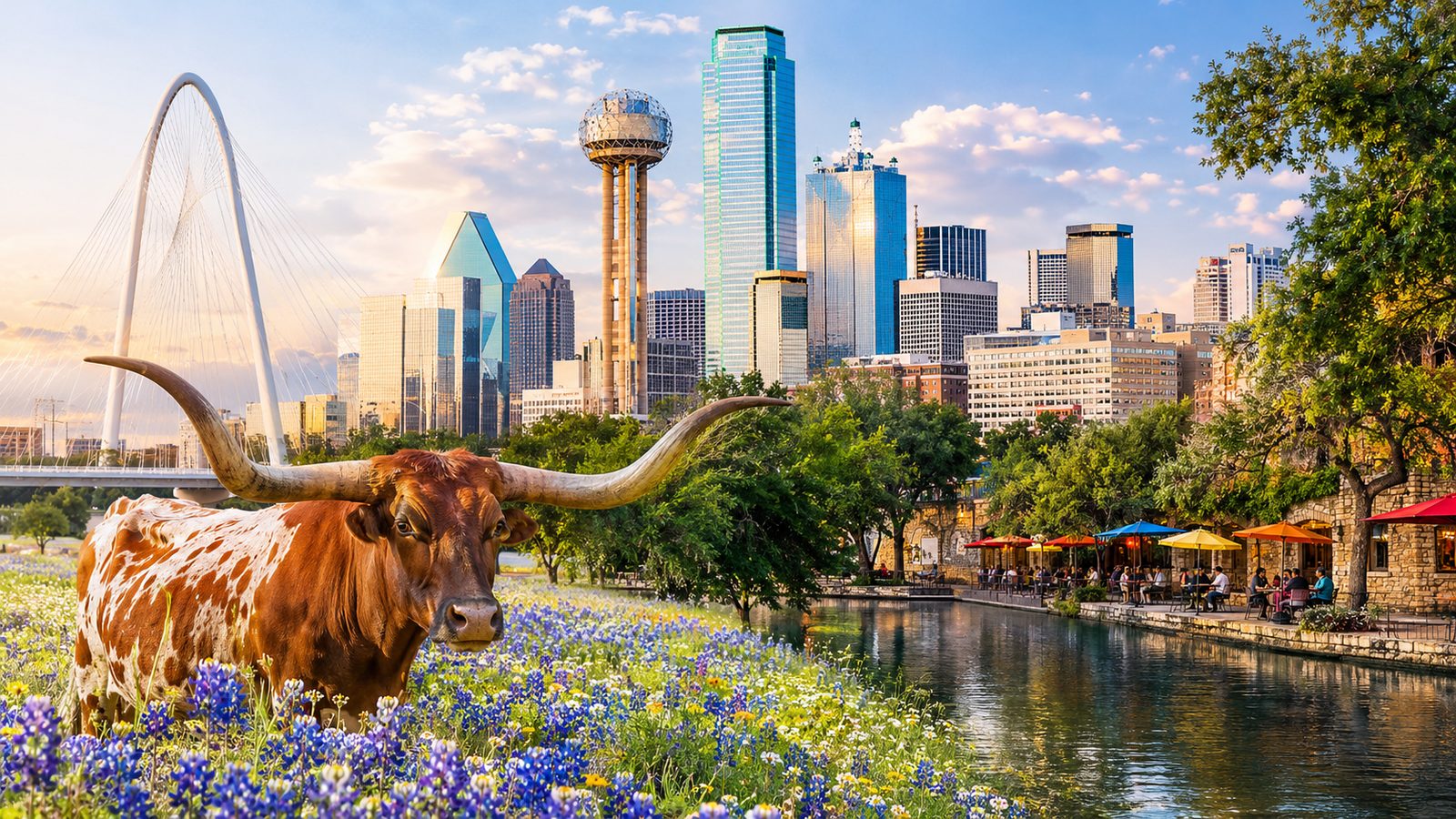
The major cities in Texas include Houston, San Antonio, Dallas, Fort Worth, Austin, El Paso, and Arlington. Texas also has several important midsize urban centers with distinct economies and regional roles. Together, these cities show how varied the Lone Star State has become. Quick answer: Houston is Texas’s largest city, with an estimated 2,397,315 residents as of July 1, 2025. San Antonio and Dallas follow, while Fort Worth and Austin have both passed one million residents. El Paso, Arlington, Corpus Christi, Plano, Lubbock, Laredo, and Irving complete the state’s 12 largest cities.
Texas Cities at a Glance
| Rank | City | 2025 Estimated Population | Region | Known For |
|---|---|---|---|---|
| 1 | Houston | 2,397,315 | Southeast Texas | Energy, medicine, space, ports |
| 2 | San Antonio | 1,548,422 | South-Central Texas | The Alamo, military, tourism |
| 3 | Dallas | 1,329,491 | North Texas | Business, finance, transportation |
| 4 | Fort Worth | 1,028,117 | North Texas | Western heritage, aviation, growth |
| 5 | Austin | 1,002,632 | Central Texas | State government, technology, music |
| 6 | El Paso | 683,012 | West Texas | Border trade, military, desert setting |
| 7 | Arlington | 402,134 | North Texas | Major sports and entertainment venues |
| 8 | Corpus Christi | 317,247 | Gulf Coast | Port, beaches, energy |
| 9 | Plano | 293,028 | North Texas | Corporate offices, suburbs |
| 10 | Lubbock | 273,071 | West Texas | Agriculture, education, health care |
| 11 | Laredo | 269,515 | South Texas | U.S.-Mexico trade |
| 12 | Irving | 257,076 | North Texas | Corporate offices, DFW access |
Population figures use U.S. Census Bureau Vintage 2025 estimates for July 1, 2025.
Key Takeaways
* Houston remains the largest city in Texas and the fourth-largest city nationally. * Five Texas cities now have populations above one million. * Fort Worth ranks ahead of Austin under the latest Census estimates. * North Texas contains several of the state’s largest cities. * City population and metropolitan population measure different geographic areas. * Border, Gulf Coast, and West Texas cities have distinct economic roles.
Major Cities in Texas by Population
Texas has five cities with more than one million residents under the latest estimates. Houston ranks first, followed by San Antonio, Dallas, Fort Worth, and Austin. Each also ranks among the 12 largest cities in the United States. The ranking changes sharply after Austin. El Paso has about 683,000 residents, while Arlington has slightly more than 402,000. Corpus Christi then begins a group of large cities below 400,000 residents. These figures measure people living within municipal boundaries. They should not be confused with metropolitan-area populations. Metro statistics include surrounding suburbs and communities beyond a city’s limits.
1. Houston
Houston is the largest city in Texas, with an estimated 2,397,315 residents in 2025. It is also the fourth-largest city in the United States. Only New York City, Los Angeles, and Chicago have larger municipal populations. Houston has major roles in energy, international trade, health care, aerospace, and transportation. The Port of Houston supports its global commercial importance. NASA’s Johnson Space Center also connects the city closely with the American space program. The wider Houston region extends far beyond the city boundary. That distinction matters when comparing city and metropolitan population figures. A metro ranking can therefore produce different numbers than a city-only list.
2. San Antonio
San Antonio ranks second in Texas with an estimated 1,548,422 residents. Its population has increased substantially since the 2020 Census base. The city gained about eight percent between 2020 and 2025. The city is strongly associated with the Alamo and the San Antonio River Walk. Tourism, military installations, health care, and government activity support its economy. San Antonio also has deep Spanish and Mexican cultural influences. Its size often surprises people comparing major American cities. San Antonio ranks seventh nationally under the 2025 estimates. That puts it ahead of several better-known coastal cities.
3. Dallas
Dallas had an estimated 1,329,491 residents in 2025. It remains Texas’s third-largest municipality and America’s ninth-largest city. Dallas is also a central part of the much larger Dallas-Fort Worth region. Business services, finance, technology, transportation, and real estate shape the local economy. The city’s central location helps make North Texas a major distribution center. Dallas Fort Worth International Airport strengthens those connections. Dallas city figures do not represent the entire North Texas urban area. Large nearby communities have separate governments and populations. That includes Fort Worth, Arlington, Plano, Irving, Frisco, and McKinney.
4. Fort Worth
Fort Worth reached an estimated population of 1,028,117 in 2025. That places it ahead of Austin in the latest Census city estimates. It also makes Fort Worth the tenth-largest city in America. The city combines a historic Western identity with a large modern economy. Aviation, manufacturing, logistics, health care, and professional services all have significant roles. Fort Worth also anchors the western side of the Dallas-Fort Worth region. Recent growth has changed its national position. Census data shows an increase of about 109,000 residents from the 2020 base. That represents growth of nearly 12 percent in five years.
5. Austin
Austin had an estimated 1,002,632 residents in 2025. It remains the fifth-largest Texas municipality after Fort Worth moved into fourth place. Austin is also the state capital. Technology companies, government agencies, universities, and creative industries have shaped the city’s growth. The University of Texas at Austin is another major institution. Music and festivals remain important parts of its national identity. Austin’s urban influence extends into surrounding Central Texas communities. Round Rock, Georgetown, Pflugerville, and other growing places form part of its wider region. Metro population figures therefore exceed the city total substantially.
6. El Paso
El Paso ranks sixth with an estimated 683,012 residents. The city sits along the U.S.-Mexico border in far West Texas. Ciudad Juárez, Mexico, lies directly across the Rio Grande. Cross-border commerce has a major influence on the local economy. Fort Bliss also gives the military an important regional presence. Health care, logistics, education, and government services provide additional employment. El Paso feels geographically different from Texas’s eastern metropolitan centers. Its desert setting reflects the broader Southwest. That geography helps give the city a distinct identity.
7. Arlington
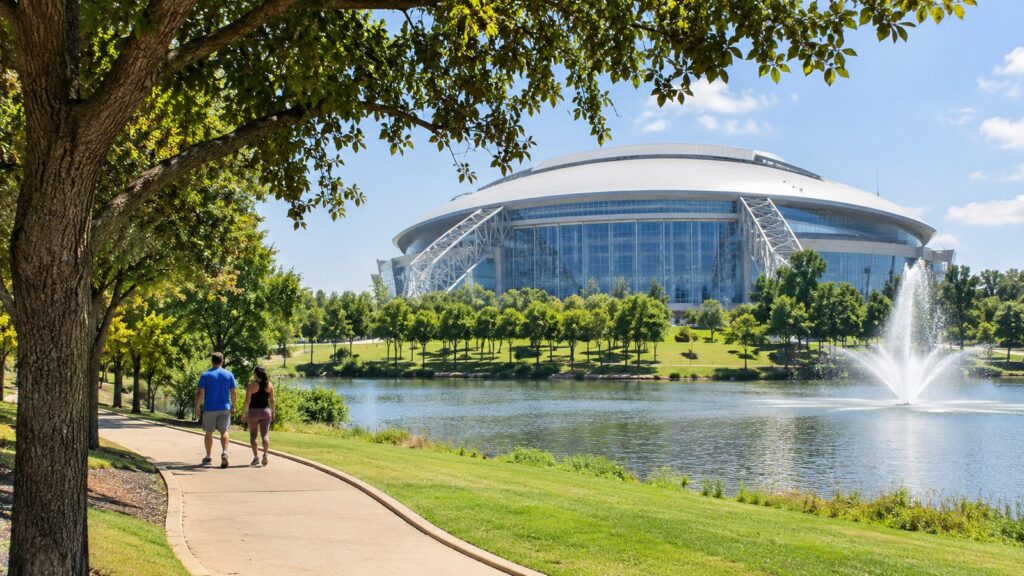
Arlington had an estimated 402,134 residents in 2025. It lies between Dallas and Fort Worth in Tarrant County. Its location makes it part of one of America’s largest metropolitan regions. The city is especially known for professional sports and entertainment. AT&T Stadium is home to the Dallas Cowboys. Globe Life Field hosts the Texas Rangers. Arlington also has manufacturing, education, and service-sector employment. The University of Texas at Arlington is a major local institution. Its position between two larger cities strengthens its regional importance.
8. Corpus Christi
Corpus Christi had an estimated population of 317,247 in 2025. It is the largest city on this list located directly along the Texas Gulf Coast. Its economy reflects that coastal position. Port activity, energy, tourism, military operations, and marine industries contribute to local employment. Beaches and nearby barrier islands also attract visitors. The city provides an urban center for a large part of South Texas. Its population has remained comparatively stable in recent years. Census estimates show a slight decline from the 2020 base. That pattern differs from rapidly expanding North Texas cities.
9. Plano
Plano reached an estimated 293,028 residents in 2025. It is located north of Dallas and forms part of the larger Dallas-Fort Worth economy. The city is primarily associated with suburban development and corporate employment. Several major companies have maintained offices or significant operations in Plano. Its location provides access to Dallas and other fast-growing northern suburbs. Transportation connections also support commuting across the region. Plano illustrates why municipal boundaries matter in population comparisons. It may function as part of a huge metro area while remaining a separate city. The same pattern applies across much of North Texas.
10. Lubbock
Lubbock had an estimated population of 273,071 in 2025. It serves as an important commercial center for the South Plains and surrounding West Texas communities. Its regional influence extends well beyond city boundaries. Texas Tech University is one of the city’s defining institutions. Agriculture, health care, education, and related services also support its economy. Cotton production remains closely connected with the surrounding region. Lubbock grew by roughly six percent from the 2020 Census base to 2025. That increase added almost 16,000 residents. It now ranks tenth among incorporated Texas cities.
11. Laredo
Laredo had an estimated 269,515 residents in 2025. It lies on the Rio Grande opposite Nuevo Laredo, Tamaulipas. Its border location makes international commerce central to the local economy. Road and rail freight move through the area between Mexico and the United States. Warehousing, customs services, logistics, and transportation therefore provide many jobs. Retail and government services also support the local economy. The city grew by more than five percent from its 2020 population base. That increase added over 14,000 residents. Laredo remains one of South Texas’s largest urban centers.
12. Irving
Irving had an estimated population of 257,076 in 2025. It sits between Dallas and Dallas Fort Worth International Airport. That location gives businesses strong regional and national transportation access. The city contains large office developments and numerous corporate operations. Las Colinas is one of its best-known commercial districts. Irving also benefits from its position within the wider Dallas-Fort Worth job market. Population growth has been modest compared with nearby Frisco or McKinney. Irving still ranks twelfth because of its established size. It remains an important part of the North Texas urban network.
Why City and Metro Population Rankings Differ
City population counts people inside official municipal boundaries. Metropolitan statistics cover a much broader labor and commuting region. They can include dozens of separately incorporated cities and suburbs. This distinction is especially important in North Texas. Dallas and Fort Worth belong to the same enormous metropolitan region. Arlington, Plano, Irving, Frisco, McKinney, and many other cities also sit within it. A source using metro figures may therefore rank Dallas-Fort Worth above Houston. A city-proper ranking places Houston clearly ahead of Dallas. Always check which geographic definition a population list uses.
Which Texas Cities Are Growing Fastest?
Growth is not limited to the state’s largest municipalities. Smaller communities around major metropolitan areas have posted some of Texas’s fastest recent gains. Celina, Fulshear, McKinney, and other communities illustrate that pattern. Among the largest cities, Fort Worth has shown particularly strong growth. Its 2025 estimate was about 11.9 percent above its 2020 Census base. San Antonio also added more than 115,000 residents over that period. Population growth can change rankings surprisingly quickly. Fort Worth’s rise above Austin is a clear recent example. Future estimates may produce additional changes among fast-growing North Texas communities.
What the Largest Texas Cities Show About the State
Texas does not have one dominant urban region. Its largest population centers are spread across the Gulf Coast, North Texas, Central Texas, West Texas, and South Texas. Each region developed around different industries and transportation networks. Houston connects strongly with ports, energy, health care, and international trade. Dallas-Fort Worth is a major corporate, logistics, and aviation center. Austin combines state government, education, and technology. San Antonio adds military activity, tourism, and a distinctive historic identity. Border cities connect Texas with Mexico through trade and culture. Coastal and West Texas centers support industries that would be harder to see from statewide totals alone. Readers researching Texas employment rules can also consult Newspaj’s FMLA Texas guide. It covers federal family and medical leave protections applying to eligible Texas workers. That topic can be useful when comparing employment considerations across Texas locations.
Frequently Asked Questions
What are the major cities in Texas?
Houston, San Antonio, Dallas, Fort Worth, and Austin are the state’s five largest cities. El Paso and Arlington form the next population tier. Corpus Christi, Plano, Lubbock, Laredo, and Irving complete the top twelve.
What is the largest city in Texas?
Houston is the largest Texas city by municipal population. The Census Bureau estimated 2,397,315 residents there on July 1, 2025. Houston also ranks fourth among all U.S. cities.
How many Texas cities have more than one million people?
Five Texas cities exceeded one million residents in the 2025 Census estimates. They are Houston, San Antonio, Dallas, Fort Worth, and Austin. Fort Worth and Austin are the newest members of that group.
Is Austin bigger than Fort Worth?
Fort Worth is currently larger under the latest Census city estimates. Fort Worth had 1,028,117 residents, while Austin had 1,002,632. Older sources may still show Austin ranked fourth because they use earlier data.
Is Dallas larger than Houston?
Houston is larger when comparing city-proper populations. Houston had about 2.4 million residents, compared with roughly 1.33 million in Dallas. Dallas-Fort Worth can rank higher when sources compare entire metropolitan regions instead.
The Bottom Line
Texas contains several of America’s biggest and fastest-changing urban centers. Houston remains the clear population leader, while San Antonio and Dallas hold second and third place. Fort Worth now ranks fourth, followed closely by Austin. Population alone does not explain each city’s importance. Trade, government, technology, energy, tourism, education, and transportation shape different regions. Understanding those differences gives a clearer picture of urban Texas. For the latest ranking, use Census city estimates rather than older population lists. Also check whether a source measures cities or metropolitan areas. That simple distinction prevents many confusing comparisons. —