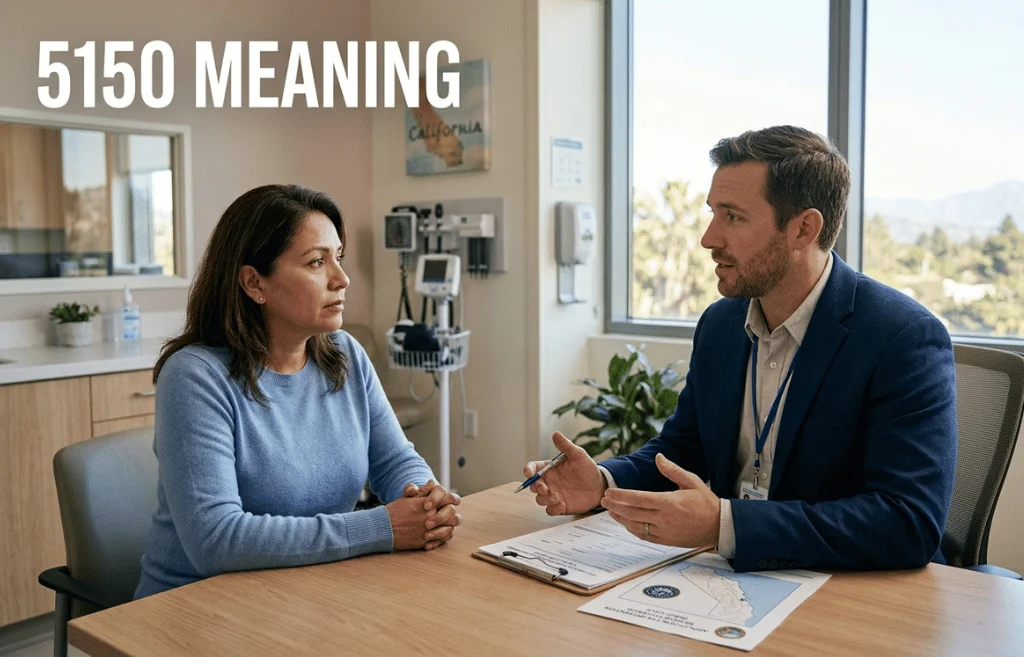
The 5150 meaning comes from Section 5150 of California’s Welfare and Institutions Code. It allows certain authorized professionals to detain a person for up to 72 hours for psychiatric assessment when specific legal criteria are met. In casual speech, the number has also become slang for someone viewed as unstable, although that usage can be stigmatizing.
| Key point | What does 5150 meaning |
| Legal source | California Welfare and Institutions Code §5150 |
| Maximum initial period | Up to 72 hours |
| Main legal criteria | Danger to self, danger to others, or grave disability |
| Who may initiate it | Certain peace officers and authorized mental health professionals |
| Slang use | Informal shorthand for a psychiatric hold or, more negatively, someone seen as unstable |
| Criminal arrest? | No. The statute distinguishes the detention from a criminal arrest. |
What Is the 5150 Meaning in California Law?

Section 5150 is part of California’s Lanterman-Petris-Short Act. The 5150 meaning refers to an emergency detention when an authorized person has probable cause to believe that the legal criteria have been met. The purpose is assessment, evaluation, crisis intervention, or placement for evaluation and treatment.
The law does not treat the person as being under criminal arrest. In appropriate cases, professionals must also consider whether voluntary or less restrictive services can meet the person’s needs.
Readers interested in related legal topics can also browse Newspaj’s law coverage.
When Can an Involuntary Hold Be Used?
California law identifies three core grounds for an involuntary hold. Because of a mental health disorder, a person may qualify if they are:
- A danger to themselves
- A danger to other people
- Gravely disabled
The meaning of “gravely disabled” has become broader under California’s updated LPS framework. In Los Angeles County, SB 43 took effect in January 2026. Under the updated definition, grave disability can include an inability to ensure personal safety or obtain necessary medical care. Severe substance use disorder may also be considered as part of a grave-disability assessment.
That does not mean unusual behavior, a disagreement, or a mental health diagnosis automatically qualifies someone for detention. The legal criteria must still be met and supported by the circumstances.
For related background on substance-use treatment, see Newspaj’s report on professional support for Xanax dependency.
How Long Does the 72-Hour Hold Last?

The key phrase is “up to 72 hours.” Under California law, the clock starts when the person is first detained rather than when they later arrive at a hospital or treatment facility. A person need not remain detained for the entire 72-hour period.
During that time, professionals assess the person and determine what should happen next. Depending on the circumstances, the person may be released, voluntarily agree to further treatment, or meet the requirements for an additional period of involuntary treatment.
California Section 5250 may allow certification for up to 14 additional days of intensive treatment when its legal requirements are met. That process also includes the right to a hearing and review.
Who Can Start the Hold?
Under Section 5150, authorized individuals may include peace officers, specified staff members at county-designated facilities, designated mobile crisis team members, and professionals authorized by the county. The process requires probable cause.
A relative or friend does not gain the legal authority to detain someone simply by requesting a hold. They can, however, report what they have observed and contact emergency, crisis, law enforcement, or mental health services. An authorized professional must then determine whether the legal standard has been met. If someone needs immediate help, contact the appropriate local emergency or crisis service.
What Does 5150 Mean in Slang or a Text?
Outside a legal or clinical setting, the number is often pronounced: “fifty-one-fifty.” In slang, it may refer to involuntary psychiatric detention or be used to describe someone as unstable. Using the term to label a person can be derogatory or dehumanizing. In a message, comment, lyric, or conversation, context usually points to one of three meanings:
- A reference to an involuntary psychiatric hold
- Slang suggesting that someone seems unstable or out of control
- A cultural reference associated with music or entertainment
The second use deserves particular care. A legal code number is not a psychiatric diagnosis, and casually labeling someone with it can add stigma to a person experiencing a mental health crisis.
The term has also appeared widely in popular culture, helping make it recognizable beyond California. For related media topics, browse Newspaj’s entertainment coverage.
Does a 5150 Hold Mean Someone Is Dangerous?
No. Being a danger to oneself or others represents two possible grounds for detention, but grave disability is a separate legal ground. Treating every detained person as violent misrepresents the law and can reinforce mental health stigma.
The detention is also part of an evaluation process. It does not prove that a person has committed a crime. The code number should not be used as a substitute for a medical diagnosis either.
For more coverage of health and emotional well-being, Newspaj also has a health section covering mental health and related topics.
What Should Family and Friends Know?

Focus on specific behavior rather than labels. If you are seeking help for someone, describe what you saw, heard, or were told. Specific observations give crisis professionals more useful information than simply saying the person seems “crazy” or unstable.
If there is no immediate danger, crisis or mental health services may be able to discuss available options. In an immediate emergency, contact the appropriate local emergency services.
The Bottom Line
The term has two meanings that should be kept separate. In California law, it refers to a specific emergency mental health detention process with defined criteria and legal protections. In everyday speech, it has become shorthand for psychiatric crisis or instability, although careless use can stigmatize people who need support. Elsewhere on the site, we look at Car Repossession Loopholes.
For more plain-language coverage, continue with Newspaj’s health articles or legal explainers. This article provides general information and is not medical or legal advice. Laws, procedures, and available crisis services can vary by location.
Frequently Asked Questions
It usually refers to an involuntary psychiatric hold. It can also be used informally to describe someone perceived as unstable. The second usage may be insulting or stigmatizing.
No. A 5150 hold is a civil mental health detention for evaluation rather than a criminal arrest.
Family members can report concerns and request help, but they do not have the authority to place someone on a 5150 hold themselves. Legal authority belongs to individuals identified under California law or authorized by the county.
The initial detention may last up to 72 hours, although it can end earlier. The statutory period begins when the person is first detained.