

If you have ever found your dog’s “magic spot,” you have probably seen a hind leg start kicking. Why do dogs kick their legs when you scratch them? The movement usually comes from an automatic nervous-system response called the scratch reflex. The kicking is involuntary, so your dog does not consciously decide to move the leg. Nerves in the skin send signals toward the spinal cord when a sensitive area receives stimulation. The spinal cord then triggers the rhythmic leg movement without requiring a conscious command.
Quick facts about the canine scratch reflex
| Question | What to know |
|---|---|
| What causes the kicking? | Skin stimulation activates a reflex pathway involving sensory nerves and the spinal cord. |
| Is the movement voluntary? | No. The hind-leg movement happens automatically. |
| Does kicking mean the dog likes it? | Not necessarily. You must also read the dog’s body language. |
| Can veterinarians use reflexes during exams? | Yes. Reflex responses can provide information about nerve and spinal-cord function. |
| When can kicking suggest a problem? | Frequent itching, licking, scratching, redness, or unusual sensitivity can point to skin disease. |
| Common causes of ongoing itching | Fleas, mites, allergies, infections, and other skin disorders can cause persistent itching. |
Why Do Dogs Kick Their Legs When You Scratch Them?
The response is called the scratch reflex, and it works like an automatic protective circuit. Sensory nerves detect stimulation when you rub, tickle, or scratch certain areas. Those signals reach the spinal cord, which activates muscles in the hind leg. This pathway allows the body to respond before the dog makes a conscious decision. A similar principle appears in familiar human reflexes, including the knee-jerk response. The fast reaction helps explain why the leg may start moving almost immediately. The reflex may have developed partly as protection against irritating insects or other things touching the skin. A flea, mite, leaf, or other irritant could activate sensitive skin receptors. Automatic scratching would give the animal a fast way to remove that irritation.
Why does the leg keep kicking rhythmically?
The movement often looks surprisingly coordinated instead of producing one simple twitch. The reflex can create repeated flexing and extending movements in the hind leg. Early neurological research studied this patterned response in dogs more than a century ago. The exact trigger area differs between individual animals. One dog may react when you scratch the belly, while another responds along the side. The strength of the reaction can also change with the location and intensity of stimulation. That variation does not automatically mean something is wrong. Normal animals can have sensitive areas where the reflex appears more easily. A sudden change in sensitivity deserves more attention, especially when other symptoms appear.
Does the kicking mean your dog enjoys the scratch?
A kicking hind leg alone does not prove that your dog enjoys what you are doing. The reflex happens automatically, even when the dog has no conscious intention to scratch. Your dog’s wider body language gives you better information about comfort. Look for a loose posture, relaxed facial muscles, and voluntary contact with you. A comfortable dog may remain nearby or reposition itself to invite more touching. These voluntary behaviors matter more than the automatic leg movement. Stop or change what you are doing when the dog stiffens or tries leaving. Other warning signs include tucked ears, a tucked tail, mouth tension, or visible eye whites. Respecting those signals makes physical interaction safer and more comfortable. Cat owners can use the same watch-the-body approach, and the Peterbald cat guide covers temperament and care for that breed. A simple consent test can help when you are uncertain. Stop scratching for several seconds and watch what your dog does next. Continuing contact or moving closer can suggest interest, while walking away communicates something different.
Veterinarians can learn from spinal reflexes
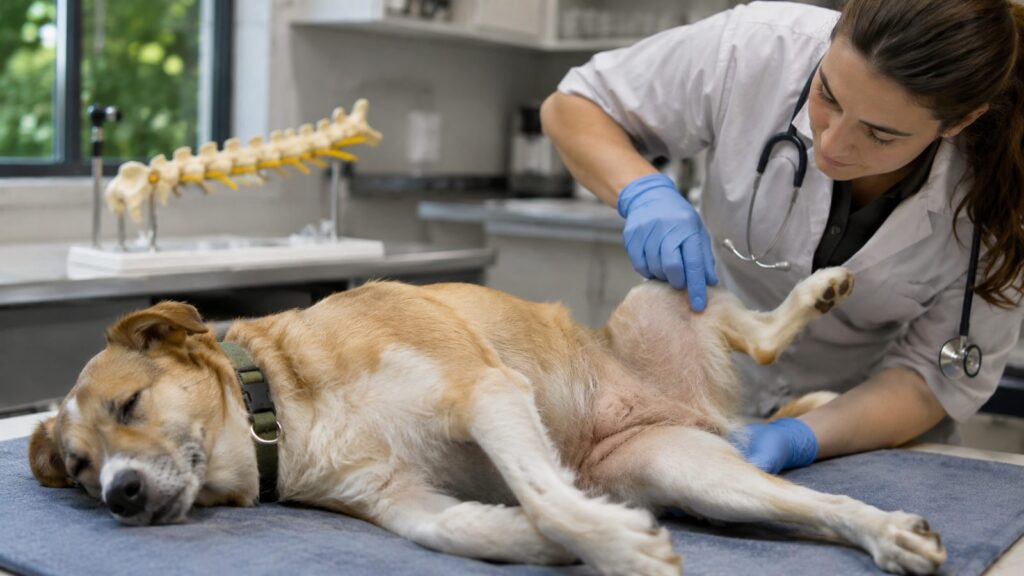
Reflex testing is part of neurological assessment in veterinary medicine. Veterinarians examine responses to help assess sensory nerves, motor nerves, muscles, and spinal-cord pathways. Abnormal responses can sometimes help localize neurological problems. The scratch response can also provide information about whether certain neural pathways are functioning. Veterinary sources note that clinicians can use reflex responses when evaluating possible nerve damage. This concept resembles the reflex tests doctors perform during human neurological examinations. Veterinarians use several different spinal reflex tests rather than relying on one reaction alone. A full neurological examination also considers posture, movement, pain responses, muscle condition, and other findings. One unusually strong or weak scratch response does not diagnose a neurological disorder by itself.
When frequent scratching may signal a skin problem
The occasional leg kick during petting is usually different from persistent itching throughout the day. Watch for frequent scratching, biting, licking, chewing, or rubbing against furniture. Those behaviors can indicate pruritus, the veterinary term for itching. Common causes include parasites, skin infections, and allergies. Fleas and mites are among the parasite problems veterinarians may consider during an itchy-dog examination. Bacterial or yeast infections can also contribute to ongoing discomfort. Allergic dogs may become unusually easy to trigger because their skin already feels irritated. A veterinarian quoted by Popular Science described this increased sensitivity in dogs with allergies. Scratching already-irritated skin can make the reflex easier to produce. Contact your veterinarian when itching becomes persistent or causes visible skin changes. Redness, hair loss, sores, odor, scabs, or repeated ear scratching deserve professional evaluation. Early assessment can identify the cause before repeated scratching causes more skin damage.
Scratch reflex versus normal scratching
A scratch reflex usually happens immediately after you stimulate a particular patch of skin. The leg often stops moving when you stop touching that area. Normal scratching can happen without anyone touching the dog first. Frequent self-scratching is more concerning because an irritant may already be present. Fleas, allergies, dermatitis, and other conditions can make an animal unusually sensitive. A new or spreading trigger area can also justify a veterinary check. One specialized example is the pinnal-pedal reflex involving the ear and hind leg. Veterinarians have studied this response as one possible clue during evaluations for canine scabies. It is only part of a diagnostic process, not proof of scabies by itself.
How to scratch your dog without relying on the leg kick
Start with gentle pressure in areas where your dog already welcomes touch. Pause regularly and allow the dog to choose whether the interaction continues. Avoid repeatedly targeting a spot solely because it produces an amusing kick. Watch the entire body instead of watching only the moving leg. Loose muscles and voluntary closeness generally provide more useful information about comfort. Stiffness, avoidance, or defensive behavior means you should stop. Routine attention to your pet’s coat and skin can also reveal problems earlier. Check for fleas, redness, thinning hair, scabs, or unusual sensitivity during normal grooming. For more pet-care reading, see the article on pet coyote ownership and care needs.
When should you call a veterinarian?
You do not usually need veterinary care because one leg kicks during a belly rub. Seek advice when the behavior appears alongside repeated itching or noticeable skin irritation. Sudden pain or marked sensitivity when touched also deserves attention. A veterinarian can check for parasites, allergies, infections, wounds, and other causes of itching. Persistent symptoms often require identifying the underlying problem instead of simply stopping scratching. Treatment depends on the diagnosis rather than the reflex itself. Neurological concerns also warrant professional assessment when movement changes extend beyond scratching sessions. Weakness, difficulty walking, unusual coordination, or abnormal pain responses need veterinary attention. Reflexes are only one part of the examination used to find the cause.
Frequently asked questions
Why do dogs kick their legs when you scratch them?
The kicking is usually an involuntary scratch reflex controlled through sensory nerves and the spinal cord. Scratching certain skin areas activates a patterned hind-leg response. The dog does not need to consciously decide to kick.
Are dogs ticklish?
Dogs respond to light touch and can show involuntary movements that resemble ticklish reactions. Scientists and veterinarians distinguish these responses from human laughter-based tickling. The scratch reflex is one automatic response to skin stimulation.
Does a kicking leg mean my dog wants more scratching?
No, the leg movement cannot answer that question by itself. Watch posture, facial expression, tail position, and whether your dog voluntarily remains nearby. Stop when your dog moves away or shows tension.
Why is my dog suddenly much itchier than usual?
A sudden increase in scratching can have several causes. Fleas, mites, allergies, or skin infections are common possibilities. Persistent itching should be evaluated by a veterinarian, especially when skin changes appear.
The bottom line
That funny kicking leg is primarily a nervous-system reflex, not a reliable happiness meter. Your dog’s voluntary body language tells you much more about whether scratching feels welcome. Frequent itching or new sensitivity deserves closer attention. Enjoy petting your dog when the interaction clearly feels comfortable for both of you. Avoid repeatedly triggering the reflex only because the movement looks funny. Contact your veterinarian when scratching becomes constant or accompanies skin, ear, pain, or movement problems. —